 0161 533 0921
  info@pkbcivils.com
You’ve designed your industrial yard to handle 40-tonne reach stackers. Your concrete spec accounts for constant HGV movements.
You’ve built for the heavy stuff.
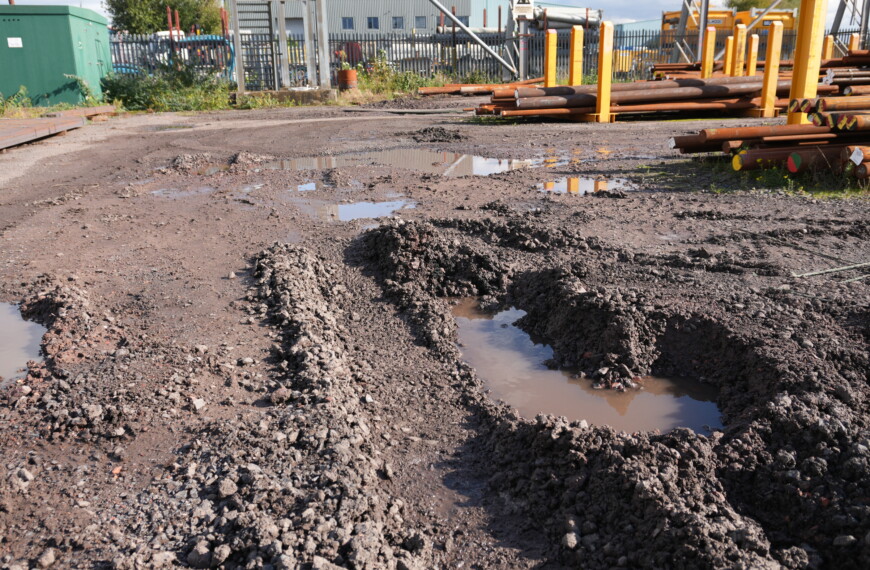
But here’s what’s actually destroying your yard: a puddle that won’t drain.
While you’re focused on load capacity and traffic patterns, water is quietly dismantling your concrete infrastructure from the inside out. And with UK winters now 16% wetter than they were 30 years ago, this silent threat is accelerating.
Let me explain why inadequate drainage poses a greater risk to your concrete than any vehicle ever will.
The three mechanisms of destruction
#1 Freeze-thaw: The Invisible Jackhammer
When water sits on poorly drained concrete, it seeps into the pores and microscopic cracks. Nothing unusual there. But when temperatures drop below freezing, which happens repeatedly throughout a UK winter – that water expands by 9%.
Think about that. Ice takes up 9% more space than water. In the confined space of concrete pores, this creates expansive forces that exceed the local tensile strength of the material. The result? Progressive cracking that deepens with every freeze-thaw cycle.
Here’s the problem: our climate has changed in ways that make this worse, not better. According to the Met Office’s 2024 State of the UK Climate Report, we’re experiencing both warmer average temperatures AND persistent cold extremes. Days that are 10°C above average have quadrupled in the past decade, yet we still get freezing nights.
This creates more freeze-thaw cycles per season, not fewer. Your concrete isn’t dealing with one long freeze anymore; it’s being hammered by repeated temperature crossings, each one driving the damage deeper.
The visual signs are distinctive: random surface cracking, surface scaling where thin layers peel away, and eventually spalling where chunks break off entirely. By the time you’re seeing spalling, the damage has been progressing for months or years.
#2 Sub-base erosion: The hidden void
Surface water is visible. The real danger is what’s happening underneath.
When drainage fails, water doesn’t just sit on top, it infiltrates through joints and cracks into your sub-base. Once there, it starts moving soil. Running water is surprisingly powerful at particle transportation. It causes washout, where soil particles are carried away, and erosion, where material gradually disappears from under your slab.
The result? Voids.
A warehouse subsidence case study documented exactly this progression. The concrete slab had been affected by downward ground movement after “inadequate water drainage, leading to softening and eroding” beneath the concrete slabs. Water had compromised the supporting sub-base, creating voids that eventually caused structural failure.
The warning signs are subtle at first: a hollow sound when you walk across certain areas, minor flexing under load, small cracks in random patterns. By the time you’re seeing visible sinking or depression, you’re looking at major structural intervention.
Foundation repair specialists confirm the mechanism: “Poor drainage—water can infiltrate the soil beneath the pavement, causing it to soften and erode. As the soil is washed away, voids can form underneath the slab.”
#3 Hydrostatic pressure: The upward force
The third mechanism is the one most people don’t consider: pressure from below.
When surface drainage systems fail and water accumulates beneath concrete slabs, hydrostatic pressure builds. This creates upward lifting forces on the slab underside, accelerates moisture-related deterioration of the concrete matrix, and enables frost heave—where expanding soil actually pushes slabs upward.
True catastrophic hydrostatic failure is rare, but the ongoing structural stress from trapped moisture is very real, particularly when combined with frost-susceptible soils.
The real costs
Let’s talk numbers, because this isn’t academic.
Repair costs:
- Surface resurfacing due to drainage damage: £30-£60 per m²
- Spalling repair: £40-£75 per m²
- Partial replacement: £100-£200 per m²
- Concrete void filling: £5,000-£20,000
- Major slab replacement: £50,000-£200,000+
For a typical 5,000 m² industrial yard requiring resurfacing due to drainage-related deterioration, you’re looking at £150,000-£300,000. Full replacement could exceed £500,000-£1,000,000.
Downtime costs:
But here’s where it gets really expensive. According to 2025 IDS-INDATA research, unplanned downtime from infrastructure failures costs UK/EU manufacturers over £80 billion annually. The average UK manufacturing downtime is £5,121 per hour. For logistics and ports, that jumps to £150,000-£300,000 per hour.
When a section of your yard fails, you’re not just paying for concrete, you’re paying for:
- Access restrictions when yard sections fail
- Safety shutdowns due to concrete hazards
- Equipment damage from uneven surfaces
- Compliance violations triggering operations suspension
The prevention premium:
Compare this to proactive drainage maintenance:
- Quarterly gully/channel cleaning: £200-£500 per visit
- Bi-annual interceptor inspection: £500-£1,000
- Annual drainage system CCTV survey: £1,500-£3,000
- Total annual preventive maintenance: £5,000-£10,000
Proactive drainage maintenance costs 5-10% of reactive repair expenses. You’re also getting extended concrete lifespan (20+ years versus 10-15 years), predictable budgeting, minimized operational disruption, and maintained safety compliance.
The UK climate context
This isn’t just about maintenance schedules. The risk profile has fundamentally changed.
The period from October 2023 to March 2024 was the wettest winter for England and Wales in over 250 years. DEFRA’s 2024 National Flood Risk Assessment found that 6.3 million UK properties are now at flood risk, including over 1.2 million commercial and industrial sites.
More relevant to your daily operations: months with rainfall at twice the average have increased by over 50% in the past decade compared to historical norms.
For ports, logistics depots, and industrial sites with large areas of hardstanding, this means:
- Prolonged standing water on concrete surfaces
- Increased infiltration into sub-bases
- Accelerated freeze-thaw and erosion cycles
Storm Babet in October 2023 alone caused over £450 million in flood damage across the UK, demonstrating what happens when water management systems are overwhelmed.
What good drainage actually looks like
The solution isn’t complicated, but it needs to be designed properly:
Surface design:
- Minimum 0.5% longitudinal gradient (this is in the DMRB standards)
- Minimum 2.5% crossfall on flat areas
- No ponding zones in the design
Sub-base specification:
- Proper compaction to prevent settlement
- Adequate depth (typically 200-350mm depending on loading)
- Quality materials with correct grading
- Integrated drainage—not bolted on as an afterthought
Drainage systems:
- Heavy-duty channel systems rated for your actual loads (E600 minimum, F900 for extreme conditions)
- Adequate gully capacity and spacing
- Oil interceptors where required (Building Regs Part H and GPP3 compliance)
- Regular maintenance schedules, not reactive callouts
At DP World’s Port of Southampton, ACO RoadDrain systems handle constant HGV freight operations while preventing surface water accumulation. The benefit isn’t just dry surfaces—it’s maintained operational uptime and protected equipment.
Ben’s take
Here’s the thing nobody wants to hear: most industrial yards are already experiencing drainage-related deterioration. Those small cracks you’re seeing? That slight hollow sound in one corner? That patch that always has water after rain? These aren’t minor issues to fix later—they’re symptoms of progressive failure.
I’ve seen operators spend six figures on yard overlays without addressing the drainage that caused the original failure. Two years later, they’re back to square one, except now they’ve got cracking in the new concrete too.
The physics doesn’t care about your budget cycle or your operational schedule. Water will find its way in, freeze-thaw will do its work, and voids will form. The only variable is whether you address it proactively or reactively.
Given that proactive drainage maintenance costs roughly 10% of reactive repairs—and prevents the downtime costs entirely—this is one of the clearest ROI decisions in facilities management.
Your yard was built to carry heavy loads. Make sure the system underneath can handle the water that’s trying to destroy it.
Next Steps
If you’re seeing warning signs – surface ponding, hollow sounds, random cracking, or areas that flex under load, don’t wait for catastrophic failure.
PKB Civils conducts comprehensive drainage assessments for industrial sites across the UK, identifying problems before they become failures. We design and install drainage systems that work with your operations, not against them.
Get in touch for a free site survey: Whether you’re dealing with an existing problem or planning new hardstanding, we’ll give you an honest evaluation and a practical solution.