 0161 533 0921
  info@pkbcivils.com
In 2024, UK insurers paid a record £650 million for flood and water damage claims, across 38,000+ incidents. That number gets attention.
The part that gets missed is what many claims hinge on: whether the site can prove its drainage and surfaces were properly maintained. (Association of British Insurers, Flood Insurance Report 2024–2025)
For facilities and building managers in ports, recycling and industrial sites, that matters because yard condition is not just an operational issue. It can become an insurance issue, a liability issue, and a cost issue all at once.
This latest article in our From The Ground Up newsletter lays out the link, using recent UK data and guidance, and then shares practical steps to reduce the risk.
Why yard condition now sits on the insurance agenda
Two pressures are rising at the same time.
- The risk is growing. The Environment Agency now assesses 4.6 million UK properties face surface water flooding risk. (Environment Agency, National assessment of flood and coastal erosion risk in England, 2024)
- insurers are tightening how they look at maintenance and reasonable precautions. If a loss is connected to something that looks gradual or avoidable, the claim can be delayed, reduced, or declined. Yard surfaces and drainage are often the first place that argument starts. (Aviva commercial policy wording and conditions, AXA commercial policy wording, Zurich SME policy wording)
What the numbers tell us about the cost of getting this wrong
Water damage and flooding losses are not small
ABI data positions 2024 as the costliest year on record for flood and water damage claims, at £650 million. (Association of British Insurers, Flood Insurance Report 2024–2025)
For commercial property, the ABI data in the research cites an average £17,400 claim value for weather damage (Q2 2025). (Association of British Insurers, Q2 2025 property claims report)
On industrial sites, the loss is rarely just the damage itself. It is the clean-up, the operational disruption, and the time it takes to settle a claim when maintenance becomes part of the discussion. (Howden Group case studies on claim disputes and settlement delays, 2024–2025)
Business interruption is rising, and cover is often uncertain
ABI quarterly figures show £102 million paid out in business interruption claims in Q4 2024. (Association of British Insurers, Quarterly claims report, Q4 2024)
At the same time, 62% of SMEs either lack business interruption cover or are unsure if they have it. (Association of British Insurers, Quarterly claims report, Q4 2024)
Even where BI cover exists, insurers expect evidence that reasonable precautions were taken, which brings you straight back to drainage and surface maintenance records. (Common commercial policy conditions across UK insurers, including reasonable precautions and maintenance conditions)
Injuries and liability claims follow the same pattern
Workplace injuries rose to 680,000 in 2024/25 (up 12.6%), and slips, trips and falls account for around 30% of incidents. (HSE, Labour Force Survey 2024/25; HSE injury causation breakdown)
The average employers’ liability payout per slip or trip claim is £21,900, before you add time off work, disruption, investigations, and reputational impact. (HSE analysis of employer and claim costs for slips and trips)
For incidents involving visitors and contractors, the research cites an average public or employers’ liability claim figure of £23,693. (UK liability claims data referenced in the research summary, 2024–2025)
Vehicle and plant damage is trending in the wrong direction
Pothole compensation claims to councils rose 90% over three years (27,731 to 53,015 in 2024), and pothole-related breakdowns averaged 71 per day in the period Sept 2024 to Sept 2025. (RAC Pothole Index 2024; RAC breakdown data Sept 2024 to Sept 2025)
While that dataset is public highways, it is a useful signal: poor surfaces cause real, frequent, costly damage. On private industrial sites, the duty to inspect and repair sits with the occupier, not the council. (RAC Pothole Index 2024, commentary on claim acceptance rates; Occupiers’ Liability Act 1957 general duty principles)
For heavy plant, drainage failure can lead to waterlogged ground and recovery can require specialist winch services at £5,000 to £15,000. (Contractors plant recovery cost benchmarks referenced in the research summary, 2024–2025)
How insurance problems actually show up
Most facility teams assume that if an incident happens, insurance will pick it up. Sometimes it does. Sometimes it becomes an argument about maintenance.
The research highlights the clauses that insurers rely on.
Wear and tear and gradual deterioration exclusions are common across commercial policies. (AXA Business Choice policy wording)
Some policies are more direct. For example, a typical commercial condition states you must keep premises, plant and equipment in good condition and remedy defects as soon as possible, and if you do not, you will not be covered and the claim will not be paid. (Aviva commercial policy wording, maintenance condition)
For defective workmanship, standard contract works policy wordings can exclude the cost that would have been incurred to rectify the defect immediately before the damage. In practice, this can mean insurers reduce claims by the cost of fixing the original defect, such as re-laying concrete to correct falls. (Contract works and all risks policy wording, LEG 2/96 defect clauses)
The point is simple. If standing water, blocked drains, or potholed surfaces are present at the time of loss, insurers may argue the proximate cause was maintenance failure, not a sudden event. (Common UK commercial policy exclusions and conditions, 2024–2025)
The research also includes an example where a settlement was reduced due to missing inspection records. (UK commercial claim example referenced in the research summary, 2024–2025)
The legal and compliance position is not optional
This is not only about insurance. It is also about duty of care.
The Workplace (Health, Safety and Welfare) Regulations 1992 require traffic routes and floors to be kept in a satisfactory state of maintenance. Standing water, blocked drains and uneven surfaces can be treated as a breach, with liability consequences if someone is injured. (Workplace (Health, Safety and Welfare) Regulations 1992, Regulation 12(2))
HSE workplace transport guidance sets out specific expectations for yard surfaces and drainage, including removing potholes, keeping drains clear, and eliminating standing water after heavy rain. The guidance also references a 1:40 camber standard to achieve adequate drainage. (HSE WPT26, workplace transport safety; HSE general maintenance guidance for workplace transport)
The research also references the 2025 SuDS national standards and the expectation of documented drainage planning and maintenance, especially on higher-risk industrial sites. (Defra, National standards for sustainable drainage systems, 2025)
Practical steps to reduce the risk
If you want to reduce both incidents and insurance issues, the aim is not perfect yards. It is controlled risk and good evidence.
1) Run a simple inspection routine and write it down
Weekly: quick walk of traffic routes, pedestrian routes, edges, joints, and known pooling areas. (HSE workplace transport maintenance principles)
Monthly: clear gullies, grids and channels as a minimum and record it. (HSE WPT26)
Quarterly: a documented inspection with photos from the same locations and angles. (HSE WPT26; insurer maintenance evidence expectations in commercial claims)
2) Treat standing water as a defect, not a nuisance
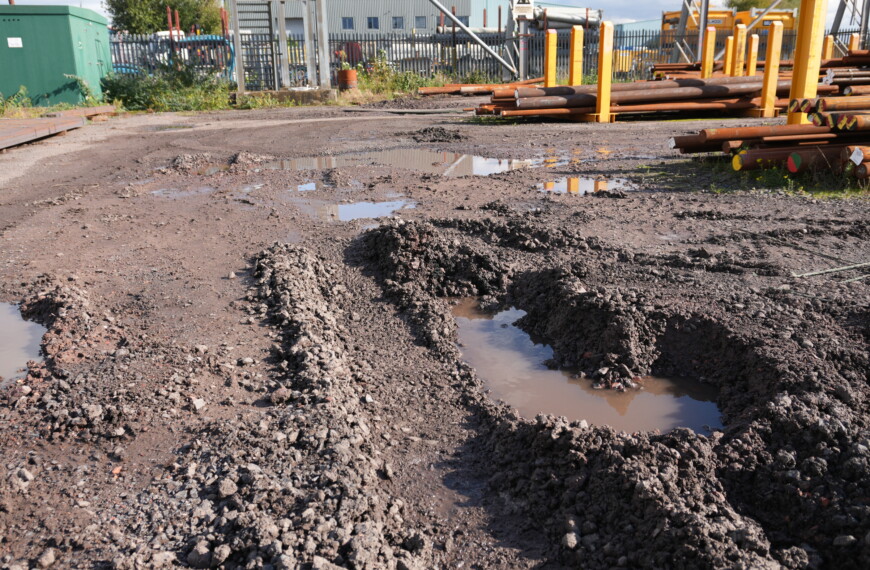
After heavy rain, identify where water remains and why, whether incorrect falls, blocked gullies, damaged channels, or restricted outfalls. (HSE WPT26)
HSE guidance is clear that standing water should be eliminated after heavy rain and drains should be cleaned regularly. (HSE WPT26)
3) Fix potholes quickly and keep a repair log
Defects above 40mm should be treated as a hazard and not left. (HSE workplace transport guidance referenced in the research summary)
Log repairs with date, location, and photos to support future claims and show a working maintenance system. (Insurer due diligence and reasonable precautions conditions, common UK policy wording)
4) Use CCTV drain surveys on a risk-based cycle
CCTV drainage surveys are increasingly expected by insurers, with typical costs of £500 to £1,500 per survey. (UK commercial drainage survey market benchmarks referenced in the research summary)
A sensible approach is every 3 to 5 years, sooner for older networks or high-risk sites. (Insurer risk management expectations referenced in the research summary)
5) Keep an insurance-ready evidence pack
Inspection checklist and dates, drain cleaning log, CCTV reports and invoices, before and after photos, and a basic site plan marking drains, slopes and known issues. (Common insurer claims evidence requirements for water damage and maintenance related disputes)
6) Make the budget case with real numbers
The research gives a clean comparison: spending £2,000 to £5,000 per year on preventative maintenance can help prevent £50,000+ claims and denials. (Cost vs claims risk comparison in the research summary)
Typical costs for planning include professional drain cleaning around £500 per day, new gully around £1,000, pothole repairs £50 to £200 each, and CCTV surveys £500 to £1,500. (HSE WPT26 cost examples and the research cost summary)
Questions to ask your broker or insurer
- What maintenance evidence do you expect for a water-related claim on our site?
- Do you require CCTV drainage surveys, and how often for our site type?
- Which exclusions would you apply if standing water or surface defects were present at the time of loss?
- If a pothole on our site damages a vehicle or plant, what proof will you need to support the claim?
- Are there any policy conditions that could void cover if we do not comply?
(Insurance and broker question set referenced in the research summary, 2024–2025)
Where PKB Civils fits in
Most facilities teams need a practical plan that works while the site stays operational:
- A yard and drainage condition review to identify high-risk areas
- A prioritised programme of repairs to reduce pooling, improve surface integrity, and fix drainage faults
- A simple record-keeping approach to support compliance and insurance expectations
Ben’s closing thought
Ignoring yard repairs is rarely a single decision. It is usually a pattern of putting off small issues until they show up as a claim, a dispute, or an incident.
Recent UK data points to the same conclusion: drainage and surface condition are now part of how risk is priced, how claims are assessed, and how liability is judged. (ABI claims data 2024–2025; HSE injury data 2024/25; Environment Agency flood risk assessment 2024; HSE WPT26 guidance)