 0161 533 0921
  info@pkbcivils.com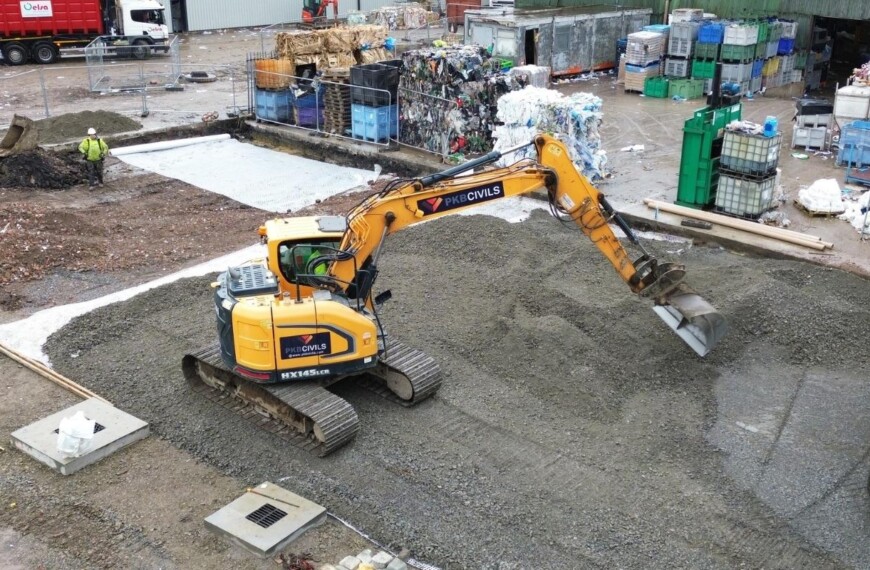

PKB Civils are plant and equipment depot yard specialists. We build and repair the concrete surfacing and drainage that keep plant hire depots operational. Plant hire depot surfacing does not wear evenly. It fails in three places, and it is the same three places on every depot: along the routes the machines drive, at the point where they are loaded onto low-loaders, and around the wash bay. All three fail for the same reason, and it is not the concrete. It is the sub-base underneath it. Which is why patching the surface buys a season and not a solution.
The assumption is usually that heavy plant is simply too heavy for the yard. The numbers say otherwise. A 20 tonne tracked excavator puts around 47 kilopascals through the ground, because that weight is spread across two large track footprints. A loaded HGV tyre puts roughly 700 kilopascals through a contact patch the size of a dinner plate (Caterpillar 320 GC specification, 2022). Standing still, the excavator is gentler on your slab than the wagon that delivers to you.
This article explains what actually causes the three failure points, what happens underneath the slab once they start, how to check your own depot, and what good specification looks like on a site that cannot stop for it.
A yard looks like one continuous surface, but it never takes one continuous load. Traffic in a depot is channelised. Machines come off the low-loader, follow the same line to the same standing area, and go back out the same way. Loading happens in the same bay because that is where the space and the access are. Everything gets washed in the wash bay, because that is where the drainage went in.
So while the yard as a whole sees moderate use, three narrow zones absorb a hugely disproportionate share of the work. If a yard were simply old and worn you would expect even deterioration. You do not get that.
You get three concentrated failures with sound concrete in between them, which tells you the surface is not the problem.
The three failure points behind almost every depot yard breakdown
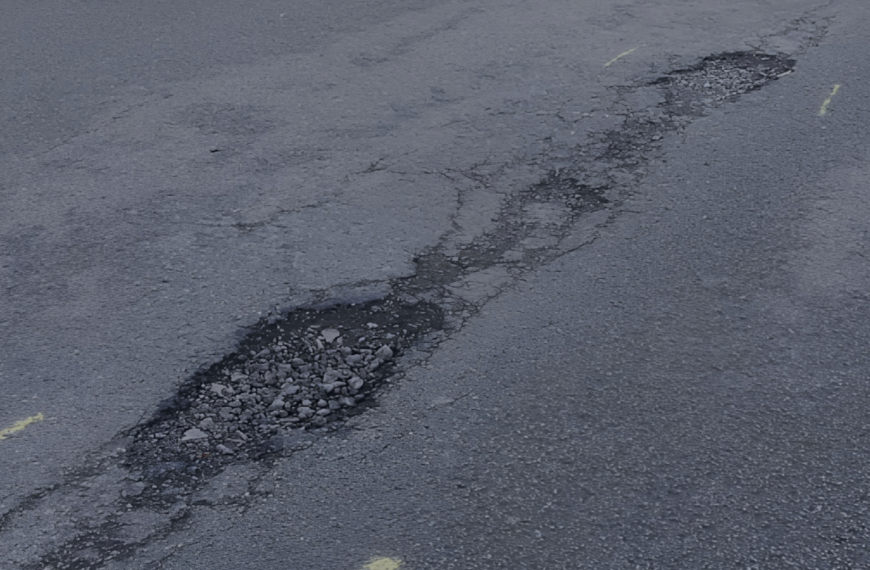
The damage you can see is the last stage, not the first. Two things are going on below it.
First, the sub-base starts pumping. Water gets in through a joint or a crack, and repeated loading pumps it back out again carrying fine material with it. Over months that migration of fines creates voids under the slab. The concrete has not got weaker, but it has lost its support, so it starts failing under loads it carried without complaint for years. There is a simple test for this: watch a joint as a loaded machine crosses it, and if water or grey slurry squeezes up out of it, the sub-base underneath is voided.
Second, patching makes it worse. A concrete slab is a load-spreading layer, and it only spreads load if something solid is holding it up. Break out four square metres of failed concrete, pour new concrete into the same hole, and you have replaced the part that was working and left the part that had failed. The patch is now a small isolated slab with four free edges and no load transfer to the concrete around it, which is the weakest thing you can build. That is why patches at a loading point often go faster than the original surface did.
A plant hire depot in Exeter shows how this gets fixed on a site that cannot stop. The fleet still had to go out every morning, which is the real reason depot yards get patched rather than rebuilt. It is a sequencing problem, not a budget one.
The yard was sectioned and rebuilt one area at a time, with a defined route in and out maintained for low-loaders throughout the programme and each section handed back before the next one started. The finished build-up was 1,000 square metres of new concrete at 200mm C40 with mesh and polyfibre over 300mm of Type 1, with nine surface water gullies, a new wash bay and new kerbing throughout.
One thousand square metres rebuilt. Nine gullies. The fleet out every morning.
An hour with a camera will tell you most of what you need to know. Look for:
The question a proper assessment then answers is whether each defect is surface-level or structural. Damage over sound support is a repair. Damage over a failed sub-base is the start of something bigger, and patching the surface only buys the failure a few months.

Surfacing on a live plant hire depot is not general groundworks. The constraints are specific: point loading from telehandlers and outriggers, turning shear from tracked plant, a fixed loading point taking repeated impact, a wash bay that has to contain what comes off the machines, and a fleet that goes out every morning regardless. A specialist approach looks like this: