 0161 533 0921
  info@pkbcivils.com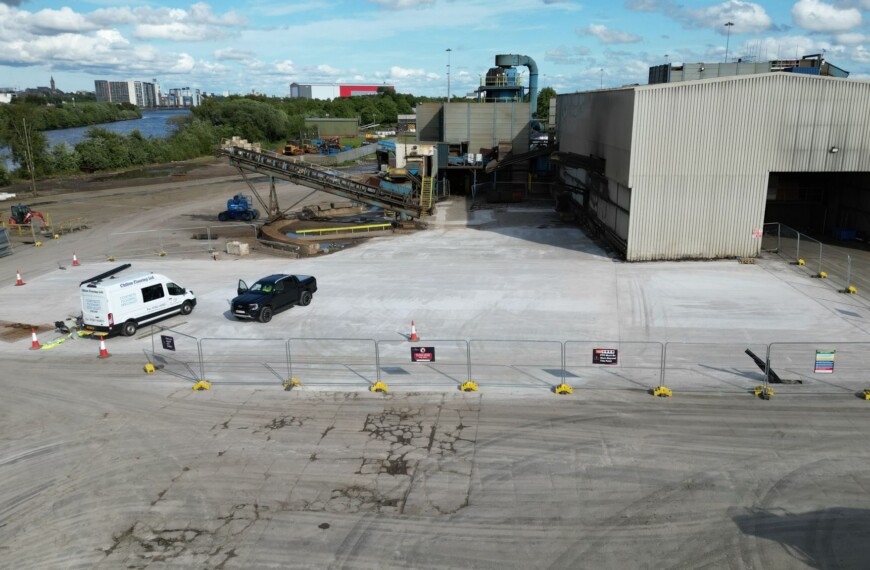

An Environment Agency (EA) waste permit doesn’t only govern what you store and process. It increasingly depends on the physical condition of your site: impermeable surfacing, sealed drainage and proper containment. As the EA steps up inspections across the waste sector, a worn surface or a failing drain can put your permit at risk. The good news is that these are fixable groundworks issues, and finding them early costs far less than being caught out.
If you own or manage a recycling centre, a transfer station or any permitted waste site, your environmental permit is your licence to operate. Lose it, and the business stops.
Most operators think of that permit as a document. In practice, more and more of it is built into the ground beneath your feet. This article explains what the EA expects from your site’s surfacing, drainage and containment, why it matters more in 2025 and 2026 than ever, and how to check whether your yard would stand up to an inspection.
Whether you hold a bespoke permit or operate under standard rules, your permit and any associated Fire Prevention Plan set conditions that are physical, not just procedural.
The main ones are:
Read together, these conditions describe a properly engineered yard: sealed, drained, contained and laid out for safety.
Two things have changed.
First, the rules have tightened. Since 31 March 2025, all workplaces in England with 10 or more employees must separate their recycling by law under Simpler Recycling, with the EA as regulator and smaller firms following by 31 March 2027 (GOV.UK, 2025).
Packaging producer fees are now live, and a deposit return scheme for drinks containers arrives in October 2027. For recycling operators, that means more material streams to handle, sort and store, which puts pressure on yard space and layout.
Second, and more importantly, enforcement has stepped up sharply.
According to the EA’s most recent Chief Regulator’s report, over half of all its prosecutions and 80% of its enforcement notices were directed at the waste sector (Environment Agency, 2025).
The government has since boosted the EA’s enforcement budget by an extra £45 million over three years, introduced police-style powers, and brought in prison sentences of up to five years for serious waste offences (GOV.UK, 2026). Between July 2024 and the end of 2025, the EA secured 122 prosecutions and shut more than 1,200 sites (Environment Agency, 2026).
The waste and recycling sector is, by some distance, the most heavily scrutinised. Inspections are more likely, and the consequences of failing one are more serious.
The hidden compliance risks in an ageing yard
Here’s the catch that surprises a lot of operators. If your permit requires an impermeable, sealed surface, then a surface that has cracked, spalled or lost its joints no longer meets the condition. It isn’t a maintenance issue you can defer. It’s a live gap between what your permit says and what your site actually does.
The same applies below ground. A drain that has cracked or silted up, a separator that no longer works, or a bund that has degraded can all mean contaminated water is reaching places it shouldn’t. You may not see it day to day. An inspector, or a pollution incident, will.
Common compliance risks hiding in plain sight include:
None of these show up in your paperwork. All of them show up when someone walks the site.
If you run the site or manage the buildings and grounds, this lands on your desk. Here’s why it’s worth getting ahead of.
In short, the condition of your yard is no longer just an operational matter. It’s a commercial and regulatory one.

PKB Civils is a specialist civil engineering contractor with more than 40 years’ experience building and maintaining hard-working industrial sites, including recycling and waste facilities across the UK. We deliver the groundworks that sit underneath your compliance:
• Impermeable concrete surfacing for reception, storage and treatment areas
• Sealed drainage, interceptors and surface-water separation
• Containment, bunding and firewater control
• Yard layouts and enabling works to support a compliant Fire Prevention Plan
To be clear about where we fit: your environmental consultant sets the standard and writes your Fire Prevention Plan. We build and maintain the physical infrastructure that meets it, and we can survey your site’s surfacing, drainage and containment against what your permit expects.
We keep your site operational, safely and efficiently, with works phased around your operations so you don’t lose production.