 0161 533 0921
  info@pkbcivils.com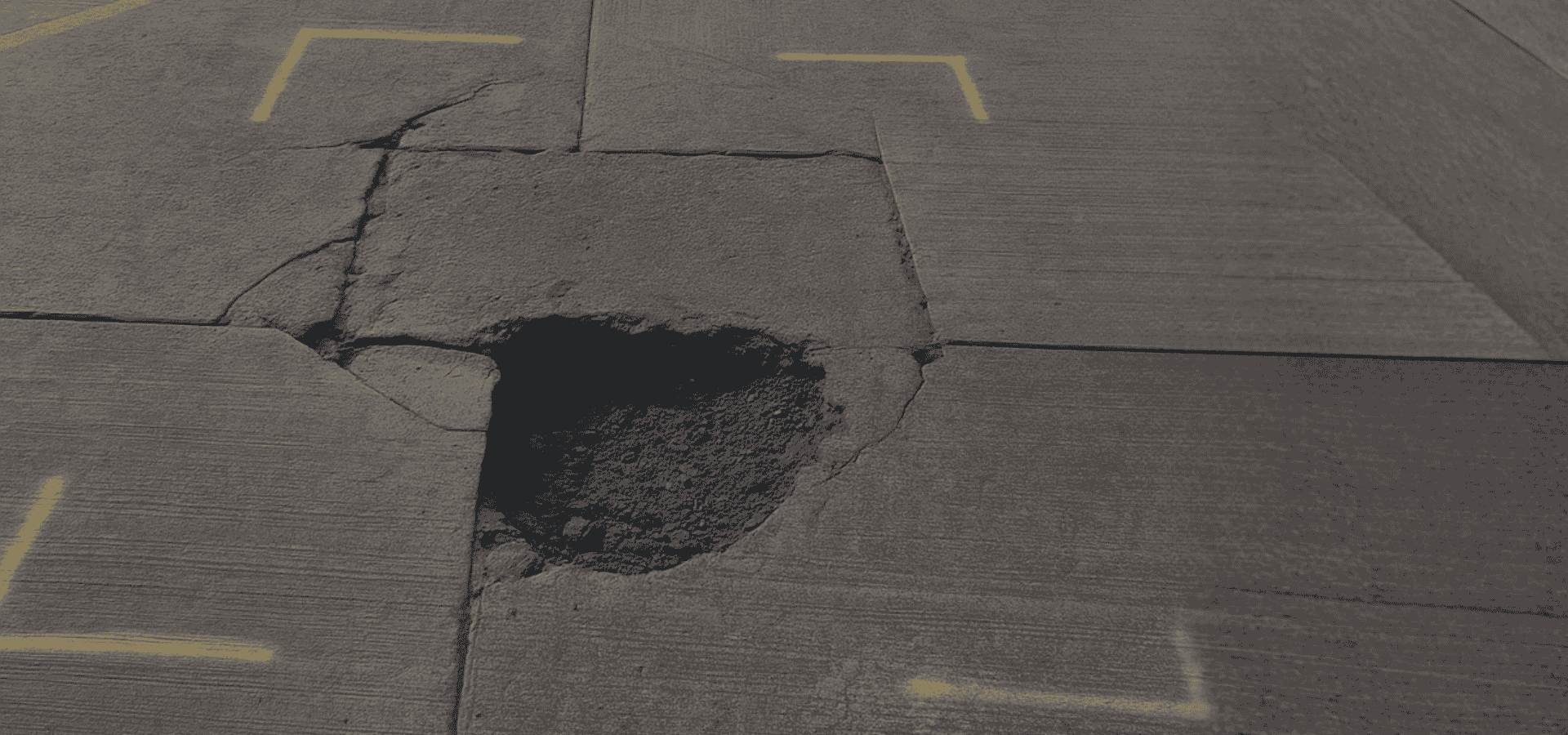
Potholes in industrial yards are not a minor maintenance inconvenience
They are a symptom of structural failure beneath the surface, and patching them without addressing the cause guarantees the problem returns. Reactive pothole repair is consistently three to five times more expensive over time than a properly specified fix. The vehicle damage, downtime, and liability exposure that accompany an unresolved pothole problem compound that cost further.
Problem Guide: Red flags to look out for on service yards
- Potholes are one of the most visible red flags in a service yard but rarely the only one present
- Where there is one structural failure there are usually others developing nearby that have not yet broken the surface
- Spotting the pattern early across the whole yard is what prevents a single repair becoming a much larger programme of works
Why potholes keep coming back
By the time a pothole is visible on the surface of an industrial yard, the damage has been developing for months. Water infiltrates hairline cracks in the surface layer, works its way into the sub-base, and weakens it over successive freeze-thaw cycles. Heavy vehicle traffic then compresses the weakened sub-base, creating voids beneath the surface. The surface fails inward and a pothole forms.
A patch repair fills the visible hole but does nothing to the compromised sub-base surrounding it. That sub-base continues to weaken under load. Within months, new failures appear adjacent to or around the patch. Each new repair creates additional joint edges that themselves become points of weakness. The cycle accelerates.
This is why facilities that have been patching the same areas repeatedly rarely see the problem diminish. The patching is not failing because the materials are poor. It is failing because the cause, whether drainage, sub-base failure, or a surface specification that was never adequate for the loads being placed on it, has not been addressed.
What potholes actually cost when you add it all up
The direct cost of a pothole repair is only the starting point. In high-traffic industrial yards, vehicle damage from pothole impacts adds considerably to the total. HGVs sustain tyre, suspension, and wheel damage from repeated impacts with surface defects. Forklifts and site vehicles are affected similarly. These costs rarely appear in the same budget line as yard maintenance, which is one reason the true cost of an unresolved pothole problem is consistently underestimated.
Beyond vehicle damage, potholes create liability exposure. A serious trip incident linked to a documented surface defect places the business in a difficult position if that defect was known and not addressed. Compensation claims, HSE involvement, and insurance complications can dwarf the repair cost many times over. And operational disruption, vehicles rerouting around damaged areas, loading bay access restricted, HGV drivers refusing to use affected zones, carries its own cost in lost productivity that is rarely captured anywhere.
Patching versus fixing: what the difference looks like in practice
A patch repair and a properly specified fix can look similar on the surface immediately after completion. The difference becomes apparent within six to eighteen months, depending on traffic volume and weather conditions.
A patch repair removes the failed surface material, fills the void with new material, and reinstates the surface. If the sub-base beneath is compromised, which it almost always is by the time a pothole is visible, the new material has nothing stable to bond to. It is effectively a surface treatment sitting on a failing foundation.
A properly specified fix identifies and addresses the sub-base failure first. Where the sub-base has failed, it is excavated, reinstated to the correct depth and specification, and compacted before the surface layer is applied. Drainage is assessed and addressed as part of the same works if it is contributing to the problem. The repair is designed to handle the loads the yard will actually carry, not just the loads the original specification assumed.
That distinction in approach is what separates a repair that lasts from one that becomes part of the recurring cycle.
Who pothole repairs are not right for
Not every pothole needs a full structural investigation. Isolated surface failures on yards with a sound sub-base and functioning drainage can often be addressed with a targeted repair that will hold. The question is whether the surrounding surface and sub-base are in good enough condition to justify a localised fix, or whether the pothole is an indicator of a wider problem that will produce further failures regardless of how well the immediate repair is carried out.
PKB Civils works exclusively on external commercial and industrial yards. If your yard is residential, internal, or falls outside that scope, we are not the right contractor and will tell you so clearly. If it does fall within our scope, a survey will tell you honestly whether a targeted repair is the right answer or whether the site needs a more comprehensive approach.
What we see on real sites
A logistics depot in the North West had been patching the same cluster of potholes for three consecutive years. Each repair held for between four and eight months before failures reappeared in and around the patched area. Our survey identified a failed sub-base across approximately 40 square metres, caused by a blocked drainage channel that had been directing water into the sub-base for an extended period. Full excavation, sub-base reinstatement, and drainage remediation resolved the problem. The area has not required repair since.
A manufacturing plant in the Midlands had a single large pothole in their main loading bay that had been patched twice in eighteen months. On survey, the surrounding concrete had carbonated to a depth that meant the surface layer had no effective bond to the sub-base across a much wider area than the visible defect suggested. A targeted slab replacement rather than a third patch repair resolved the issue permanently and at a lower total cost than a fourth round of patching would have eventually required.

FAQ's
The clearest indicator is recurrence. If a pothole has been repaired and returned within twelve months, the sub-base beneath it has almost certainly not been addressed. A condition survey will confirm whether the issue is localised to the surface or indicates a wider sub-base or drainage failure that needs resolving properly.
Yes. We handle both targeted pothole repairs and wider resurfacing and sub-base remediation works on external commercial and industrial yards. All works are specified to handle the loads imposed by HGVs, forklifts, and heavy plant. We do not undertake residential or internal works.
Patching the same pothole for the third time?
Send your brief and we will tell you whether the problem is structural, what is causing it, and what a lasting fix would actually involve.